Thursday, June 18, 2015

PEAS ON EARTH--Follow that pea.

Fresh to Frozen
Learning on the Land-Part 3

(Click to see Part 1 or Part 2)

Up to this point, the peas have been outside the main processing building where water and machinery are used to separate the edible pea from all foreign material. In the next stage the peas travel inside and enter what I like to call "Pea-Pickin' Water Park."


Triple washing cleans the peas and rids them of any remaining residue that may have made it this far.


And then the peas enter a series of

chutes, 
slides,  
 
and troughs. 
Wheeeeeeeeee!


Next they are blanched with multiple sprays of hot water . . .


followed by a cold, cold shower that stops all enzyme action.


The final fun in the 'water park' is the 's-PEA-dway,' where peas race across a grated surface for the final sort for uniform size.


Next, it's on to the freezer. . .
 

Brrrrrrr . . .


Voila! Frozen peas.

From harvest to frozen takes only four hours!


Finally, frozen peas are stored in huge totes until they are bagged for an order for a vendor such as Birds Eye/C&W.

(Click to see Part 1 or Part 2)

Tuesday, June 16, 2015

PEAS ON EARTH--The Next Step


From Field to Processor
Learning on the Land-Part 2

Once harvested, the peas we saw being harvested in the morning (see Part 1) are trucked from H.T. Rea pea field to Smith Frozen Foods, Inc. in Weston, Oregon. In 1952, twenty food processors existed in the Blue Mountain region including canneries and frozen food processors. Today, Smith Frozen Foods is the only processor left in the Blue Mountain region.


Before being weighed, the peas are dumped into a huge hopper where the process begins to separate the round green peas from any extraneous pods or field residue that may have been collected. Even with the best harvesting techniques, some foreign material makes it through to this first stage of processing and must be removed before the peas are weighed and the farmer gets paid for his peas.


In addition to weight, random samples are taken from every load of peas to test for maturity grade using this machine--a tenderometer. The maturity grade is important to both the processor as well as the grower as a basis for establishing value of the crop and payment by the processor. In short, tender peas pay more to the grower.


Separating good peas from the field detritus is a three-stage process where the peas are rolled, tumbled, and sifted . . .


. . . until only the best whole peas remain to be washed, blanched, and quick frozen. 

Stay tuned for Part 3 to see that process. Click here to see Part 1.

Monday, June 15, 2015

MURAL MONDAY: Favorite Childhood Books

How many characters from children's books can you find?


Here's the panoramic view (above) with individual sections (below)


All of these favorites, and more, are available at the Walla Walla Public Library.

Sunday, June 14, 2015

PEAS ON EARTH: A brief history of vines

Learning on the Land--Part 1

Learning on the Land is the community education program of the Blue Mountain Land Trust, a non-profit organization whose mission is to "collaborate with communities and landowners to conserve the scenic, natural, and working lands that characterize the Blue Mountain region." This series of outings offers a wide variety of topics and events to connect the greater Walla Walla community with the surrounding land. Peas on Earth is one of these.


Long before the first wine grape was grown in the Walla Walla valley, another plant grew on vines--peas. While wheat has been the undisputed agricultural king in the Blue Mountain area as long as the land has been farmed, peas have been among the other crops that have played important roles in the life and economy of the Walla Walla Valley. But their heyday as a agricultural headliner is almost a memory. 

Due to a loss of food processors in the region over the years, less and less acreage is devoted to growing green peas. Today, the H.T. Rea Farming Company, a four-generation family farm, operates one of the largest farms in the area that still grows green peas.


An abundance of rain in May caused pea vines to grow and swell; however a week of 100+ degree temperatures in June caused these same vines to stress which can be seen in the subtle yellowing. Time to harvest!


 Working ahead of the multiple viners, the swather (back center) cuts down the vines leaving them in neat rows. 


Next come the viners that crawl along the rows of downed vines, each one offset from the other, and in a multi-task operation pick up the vines, then shake, beat, roll and vibrate the pods which releases the peas into a holding tank.


 Finally, the spent pea vines and pea-less pods are spit out the back.


Yes, those pods look in tact, but when they exit the viner, they are indeed without the individual peas. 


As the holding tank fills up, a tractor pulling a large bucket-wagon pulls up along side the viner, and the peas are off-loaded. On this day, one wagon serviced seven viners which meant the driver was constantly busy collecting peas and then . . .


. . .dumping the full bucket into a waiting pea truck which will take them to Smith Frozen Foods where they will be processed. 

From field to frozen takes only four hours! Stay tuned for Part-2, a tour of Smith Frozen Foods, the lone green pea processor in the area where in 1952 there were 20 food processors in the Blue Mountain region.

Thursday, June 11, 2015

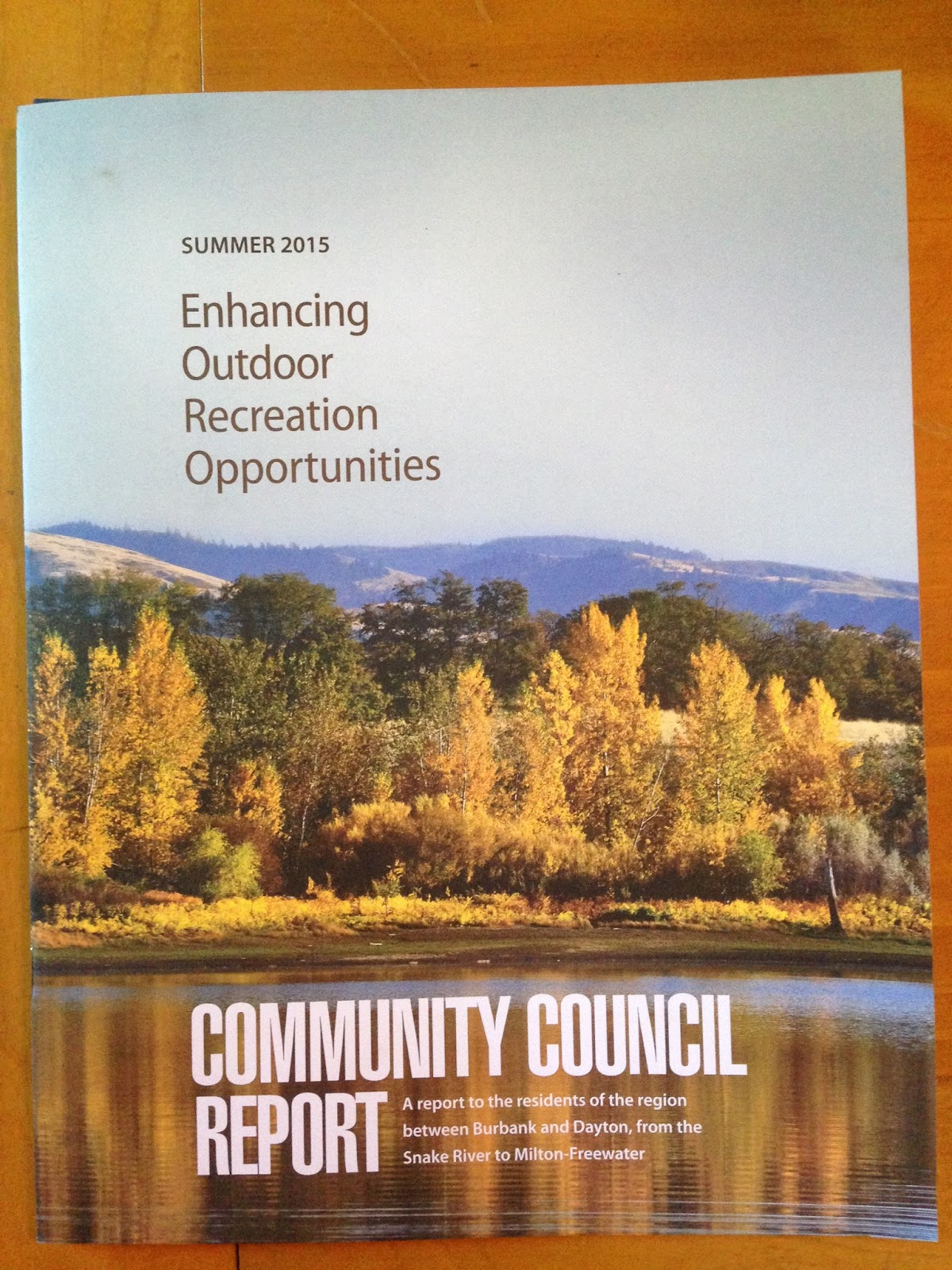
COMMUNITY COUNCIL REPORT--SUMMER 2015

Becoming a Part of the Process


I attended my first general meeting of the Community Council this week where the results of the current study--Enhancing Outdoor Recreation Activities--were presented. What an impressive organization!

The Community Council facilitates a citizen-driven, consensus-based problem-solving process to prepare the greater Walla Walla area for future growth, change and challenges. The Community Council encourages the participation of all residents of the region. 


The study process is carried out by three committees each composed of community members: the program committee, the study committee and the implementation task force. The results of the study committee presented at this week's annual luncheon meeting has now been turned over to the implementation task force. The board of directors commits the Community Council to support this implementation effort for two years.


These are the topics studied and implemented since the beginning of Community Council in 2007. Each year the Community Council seeks suggestions from its members, community leaders and the general public to help determine the topic for its next Study. 

Wednesday, June 10, 2015